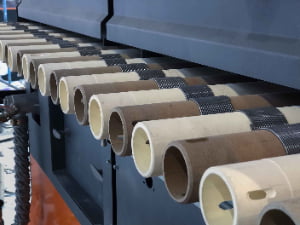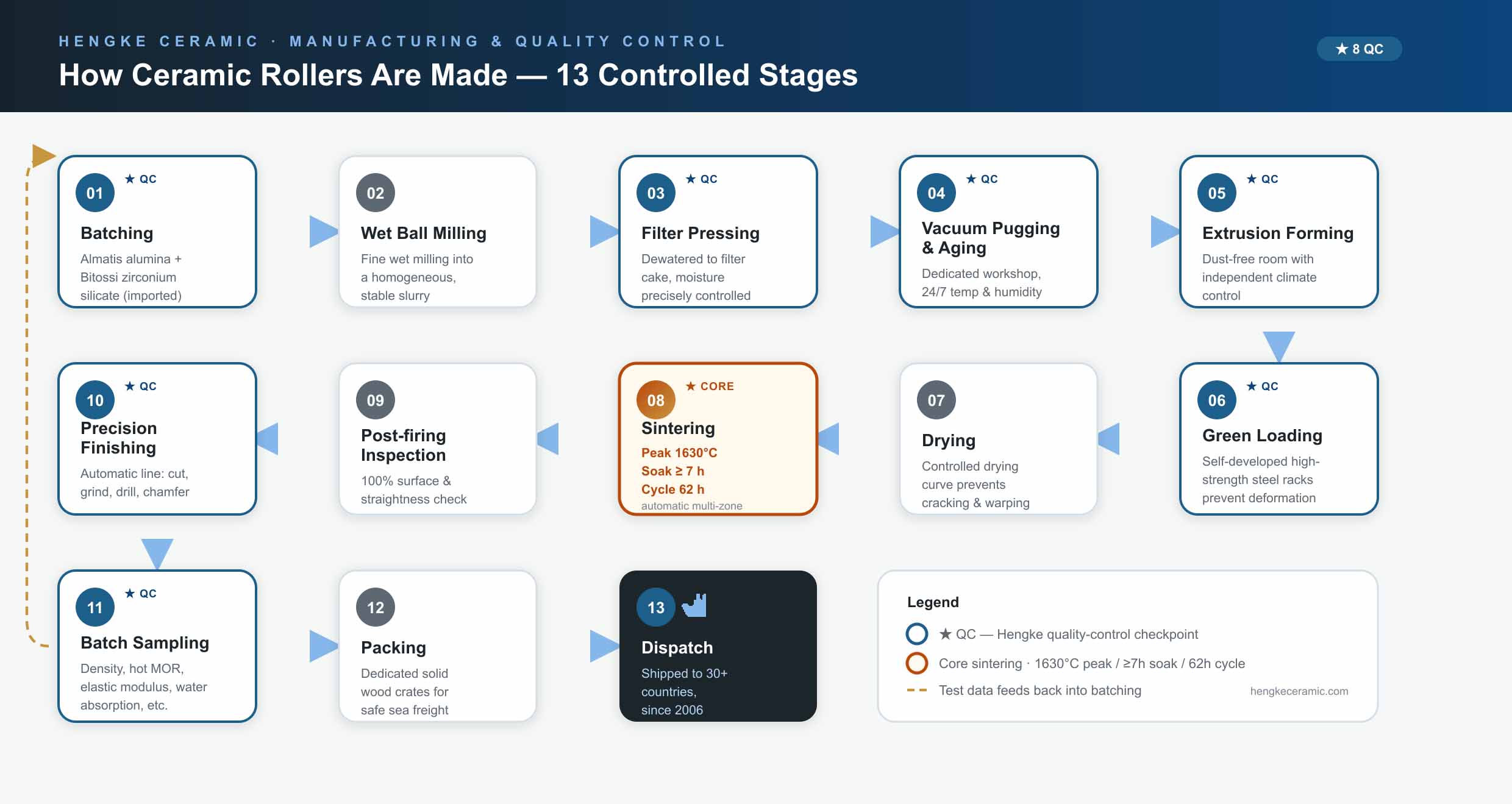
A ceramic roller looks simple — a straight, hollow tube. But inside a roller-hearth kiln running at 1,200°C and above, every one of those tubes has to stay straight, carry load, and turn smoothly for months without contaminating the tiles it carries. That reliability is not luck. It is the result of a controlled sequence of stages, each with its own quality checkpoint, from the powder that goes into the batch to the final measurement before packing.
This article walks through how extruded alumina ceramic rollers are made at Hengke, stage by stage, and points out where quality is controlled along the way.
Hengke Ceramic is a specialist manufacturer of industrial ceramics based in Zibo, China, supplying ceramic rollers and wear-resistant solutions to kiln operators and manufacturers in 30+ countries since 2006.
Stage 1 — Raw Material Batching
Everything downstream depends on what goes into the batch. The main body material is high-purity alumina powder, combined with zirconium silicate and sintering additives in a controlled recipe. The choice of raw material supplier matters more than most buyers realize. At Hengke, the alumina powder is sourced from Almatis (a leading global alumina producer) and the zirconium silicate from Bitossi in Italy. Consistent, high-grade inputs are the foundation of batch-to-batch consistency — the single quality most kiln operators care about, because a roller that performs well in the first order but varies in the next is a production risk.Stage 2 — Wet Ball Milling
The batched materials are wet-milled to refine and homogenize the particles into a stable slurry. Proper milling ensures an even particle-size distribution, which later translates into uniform density in the fired roller.Stage 3 — Filter Pressing
The slurry is dewatered by a filter press into a filter cake with precisely controlled moisture content. This step takes place in a dedicated clay-preparation workshop that is physically separated from the kiln area — keeping heat, dust, and humidity swings away from the clay body.Stage 4 — Vacuum Pugging and Aging
The filter cake is processed through a vacuum pug mill, which removes trapped air, plasticizes the body, and homogenizes it. Removing air is critical: trapped bubbles become pores during firing, and pores weaken the roller. After pugging, the clay is aged so that moisture and plasticity even out completely before forming. Throughout this stage, the workshop is monitored around the clock to hold the clay body at its optimal temperature and humidity. This consistency is what makes the difference in the straightness and density of the finished roller.Stage 5 — Extrusion Forming
The prepared clay is extruded into hollow roller blanks with a uniform, dense cross-section. Forming is carried out in a dedicated, dust-free room with independent temperature and humidity control, so that environmental fluctuation cannot affect the green body as it is shaped.Stage 6 — Green Roller Loading
Freshly extruded rollers are still soft and easily deformed. How they are loaded onto kiln racks directly affects their final shape. Hengke uses self-developed, high-strength steel loading racks — a proprietary structure and material designed to prevent any deformation during loading and handling. The goal of this stage is a perfect pre-firing state: a roller that enters the kiln perfectly straight will develop uniform internal stress after firing. A roller that enters slightly bent never fully recovers.Stage 7 — Drying
Before firing, the green rollers are dried on a strictly controlled drying curve. Drying too fast causes cracking; drying unevenly causes warping. A managed curve avoids both.Stage 8 — Automatic Multi-Zone Sintering
This is the core stage, where a dried clay tube becomes a dense, high-strength ceramic. Firing is done in a fully automatic, multi-zone kiln that controls temperature precisely from zone to zone. At Hengke, the process reaches a peak soak temperature of 1,630°C, holds that soak for at least 7 hours, and runs a total kiln cycle of 62 hours. A long, high, evenly controlled firing cycle is what drives full densification and produces a stable, uniform microstructure across the entire length of the roller — which is what gives the roller its strength and dimensional stability in service.Stage 9 — Post-Firing Inspection
Every fired roller is inspected — 100%, not by sampling — for surface quality and straightness, against Hengke's factory standard. Rollers that do not meet the standard are removed here, before any further processing is spent on them.Stage 10 — Precision Finishing
Fired rollers are finished on a fully automatic line that handles cutting to length, end grinding, drilling, and chamfering. Automating this line keeps end-machining precision consistent from one roller to the next, which matters when a customer is installing hundreds of rollers into a single kiln.Stage 11 — Batch Sampling and Testing
Beyond the 100% straightness and surface inspection, every kiln batch is sampled and laboratory-tested for bulk density, hot modulus of rupture (bending strength at temperature), elastic modulus, water absorption, and other properties. These results are not just a pass/fail gate. They are fed back to the technical team and, when needed, back into raw material batching and process parameters — a closed quality loop that lets each batch inform the next. This is how a manufacturer moves from "inspecting out" defects to steadily improving the process itself.Stage 12 — Packing
Finished rollers are packed in dedicated solid wood crates built to protect them through long-distance sea freight. Ceramic rollers are strong in compression but vulnerable to impact and point loads in transit, so packing is a genuine part of quality — not an afterthought.Stage 13 — Dispatch
Packed rollers are loaded and shipped to customers across Europe and 30+ countries, as Hengke has done since 2006.Why the Process Matters to a Kiln Operator
For a tile or slab producer, a ceramic roller is a consumable that the entire line depends on. A single roller that sags, breaks, or runs out of round can mark product, cause downtime, or damage a kiln zone. The features that prevent this are all decided upstream, in the process above:- Batch-to-batch consistency comes from controlled raw materials (Stage 1) and the closed test-feedback loop (Stage 11).
- Straightness comes from clay preparation (Stages 3–4), careful green loading (Stage 6), and controlled drying (Stage 7).
- Strength and thermal-shock resistance come from the sintering profile (Stage 8).
- Dimensional precision at the ends comes from automated finishing (Stage 10).
Hengke Ceramic is a specialist manufacturer of industrial ceramics based in Zibo, China, supplying ceramic rollers and wear-resistant solutions to kiln operators and manufacturers in 30+ countries since 2006.